Why the Same Ocean View Costs Less in Ojochal Than in Uvita
September 24, 2026
September 24, 2026
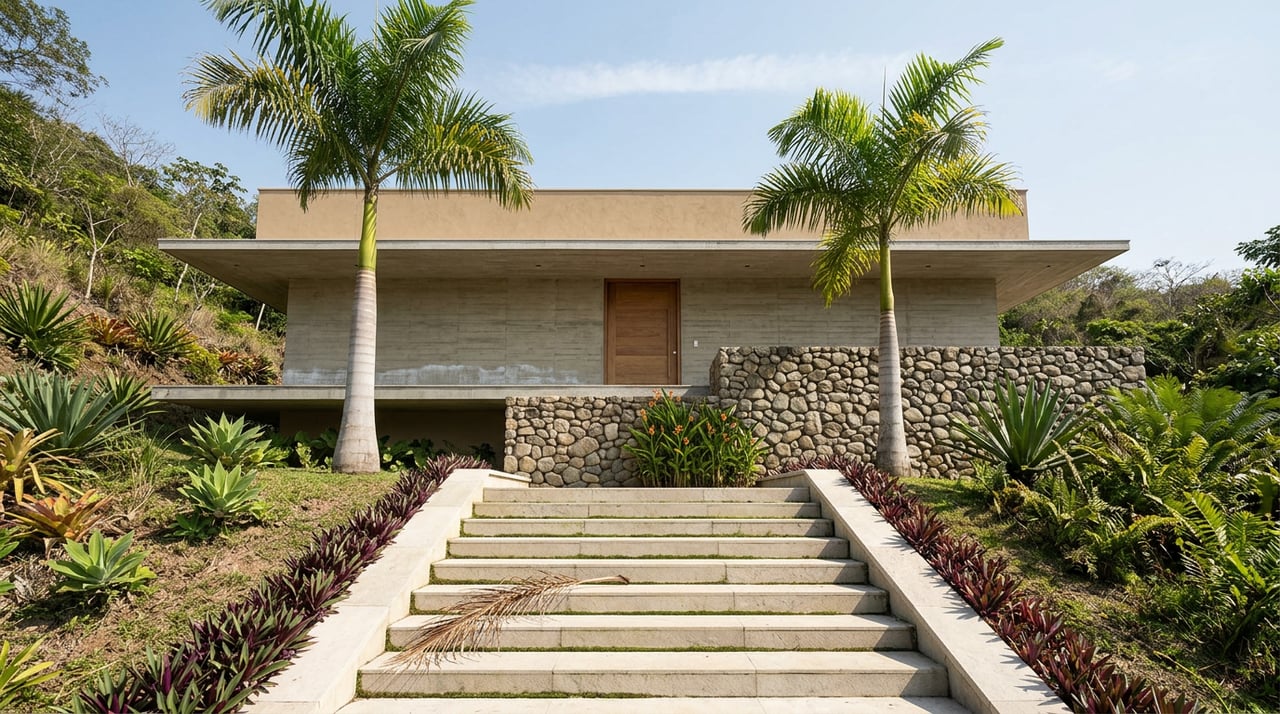
Pull up two listings side by side, an Ojochal hillside lot and a Uvita hillside lot, similar ridge, similar elevation, comparable Pacific view, and the gap is real. Ojochal's version typically runs 15 to 25 percent less per square meter for comparable ocean-view acreage. Most explanations for that gap stop at "Ojochal is smaller" or "Ojochal is quieter," as though the town simply hasn't caught up yet. That explanation is incomplete. The real driver is a canton-level zoning history that has kept large hotel and resort development from taking root here the way it has along Guanacaste's coast, and it means the price gap is not a temporary discount waiting to close. It is closer to a structural feature of how this stretch of the Southern Zone was allowed to grow.
Ojochal sits inside the Bahía Ballena district of Osa canton, the municipal government that also oversees the coastline running south toward the Térraba-Sierpe wetlands. Osa canton operates under a coastal zoning framework designed to balance tourism-driven growth with the conservation obligations that come with sharing a coastline near some of the country's most protected land. That framework does the opposite of what a resort brand needs. It makes large-scale, high-density coastal development slower to approve, not faster.
Compare that to Guanacaste's Gold Coast, where decades of resort-anchored planning built the roads, airport connections, and brand recognition that pushed land values up across entire corridors. Properties there now sit near names like the Four Seasons and the JW Marriott, the kind of anchor investment that reshapes what neighboring land is worth. Uvita, sitting closer to that northward pull and to the growing visitor economy around Marino Ballena National Park, has started to feel some of that pressure spill south. Ojochal has not, largely because the canton's zoning has never made it easy for anyone to build at that scale here in the first place.
What did grow in Ojochal is infrastructure built for residents, not resort guests. Plaza Ventanas, on the coastal highway between the village and the beach, is the clearest evidence. Its roughly two dozen rental units house a pharmacy, a dental clinic, a medical clinic, an attorney's office, a French bakery and café, and a sushi restaurant, the kind of tenant mix a hotel corridor rarely prioritizes but a town full of full-time residents does. The gas station attached to the plaza is the only one along the 44-kilometer stretch of highway between Uvita and Palmar, which says something about how thin services still are outside the two or three commercial centers that exist in the area.
That tenant mix tells you what kind of market this is:
A resort corridor tends to build spas and beach clubs first and clinics later, if at all. Ojochal built the clinic first.
Pull current land listings in Ojochal and the supply side tells the same story. Small in-village or roadside lots start under $60,000 for a fifth to a third of an acre. Mid-size hillside parcels with partial or full ocean views typically run from $150,000 to $250,000 for one to three acres. The largest agricultural or development-scale fincas stretch well past $1 million for parcels measured in dozens of acres, with some of the larger tracts near 85 acres priced above $2 million. Homes follow a similar band: modest resales and fixer-uppers under $300,000, well-built three to four bedroom homes in the $300,000 to $600,000 range in established phases like Aves del Sur or Puesta del Sol, and estate-level properties above $1 million with panoramic Pacific views and larger acreage.
| Property type | Typical size | Approximate price range |
|---|---|---|
| Village or roadside building lot | 0.2 to 0.4 acre | $40,000 to $75,000 |
| Hillside ocean-view lot | 1 to 3 acres | $150,000 to $250,000 |
| Established-phase home, 3 to 4 bedrooms | Varies | $300,000 to $600,000 |
| Estate-level home with panoramic views | Larger lot | $1,000,000 and up |
| Large finca or development-scale parcel | 20 or more acres | $1,000,000 to $2,500,000 and up |
None of those price points look unusual for the Southern Zone in isolation. What is unusual is how much land, elevation, and view corridor a buyer gets at each tier compared to the equivalent Uvita listing, and that gap tracks with the zoning constraint rather than with anything about construction quality or finish level. A three-bedroom home on a ridge in Ojochal is not a lesser version of its Uvita counterpart. It is priced by a market that has never had to compete with a resort-scale buyer pool for the same land.
If your search has bounced between Ojochal and Uvita and the price difference has made you suspicious of Ojochal, the suspicion is pointed at the wrong variable. The gap is not telling you Ojochal is behind. It is telling you that Ojochal's land was never priced against a resort-scale buyer pool, because the canton's zoning never let that buyer pool form here the way it has elsewhere on the coast.
That distinction has practical consequences depending on what you are optimizing for. A buyer who wants full infrastructure, paved internal roads, and a gated-community feel closest to what a Guanacaste beach town offers will find that trade-off already built out inland, in a zone like Tres Rios. A buyer whose priority is acreage, privacy, and a lower entry price for hillside ocean views, and who is comfortable with more variable road and utility conditions depending on the specific parcel, will find that further out, in zones like Coronado, where lots run larger and quieter at the cost of some of that polish.
It also means the comparison itself is doing real work. A buyer who only looks at Ojochal's median price without understanding why it sits where it does will misjudge how long that price relationship is likely to hold. Zoning frameworks do not move on a market cycle. They move when a canton government formally revises its regulatory plan, a slower and more deliberate process than a hot buying season.
Does a lower price in Ojochal mean lower construction quality? Not inherently. Construction quality across the Southern Zone varies by builder and by buyer budget in both towns, not by which side of the Ojochal-Uvita line a property sits on. The price gap described here is about land economics, not build quality, and due diligence on any specific home should evaluate its own construction record independently of the town it happens to sit in.
Could Ojochal's zoning advantage change? Regulatory plans can be revised by canton governments, and it is worth remembering that a meaningful share of Costa Rica's coastline still operates without any approved zoning plan at all, which leaves room for change in either direction over time. Nothing in the current framework suggests an imminent shift, but any buyer weighing a parcel specifically for its zoning position should confirm that property's current zoning status directly with the municipality before treating today's price relationship as permanent.
If you are trying to work out what a specific lot or home in Ojochal or Uvita is actually priced against, and whether that price makes sense given what is buildable on it, that is the kind of question worth answering before you make an offer, not after. Tropical Investments works across the Southern Zone with exactly this kind of comparison in mind. Browse Properties to see what is currently available in both towns.

It would be our honor to help you find the perfect Costa Rica real estate opportunity that matches your lifestyle and interests. Connect with us to get started on your real estate in Costa Rica journey!
Plaza Coco Uvita Local 6 2nd FL, Bahia Ballena, Puntarenas 60504, Costa Rica