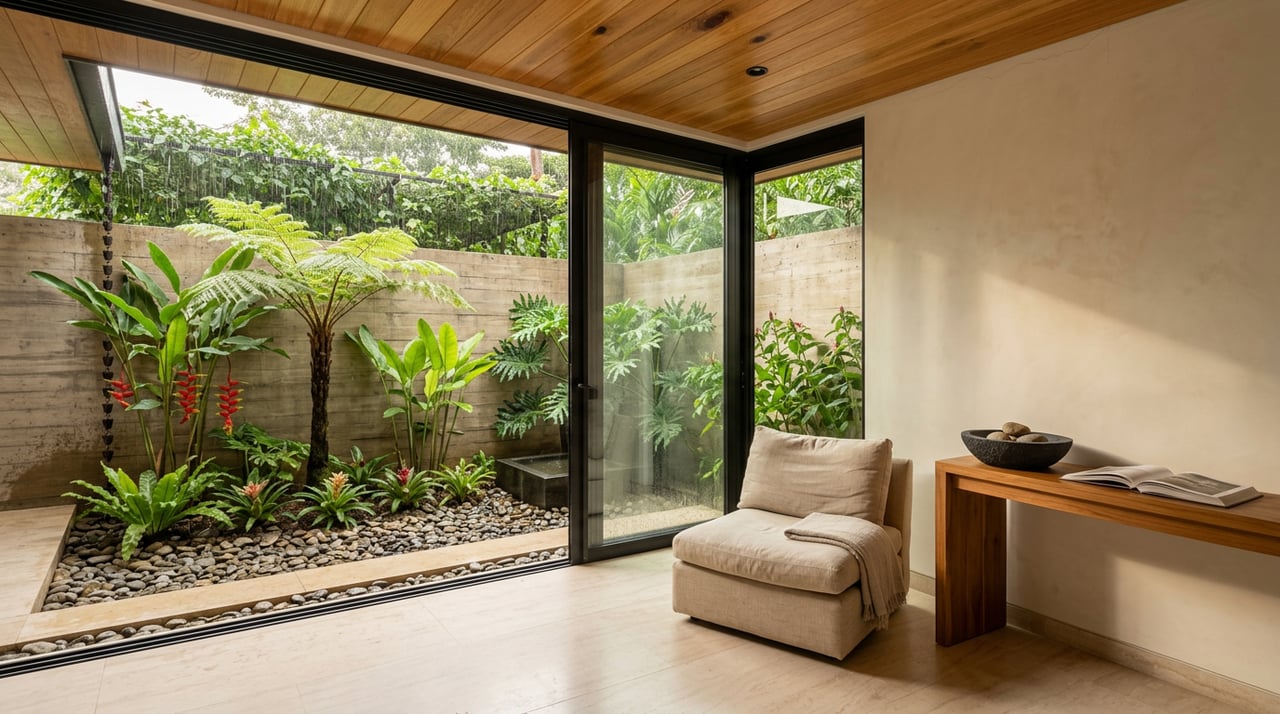
August in Nosara: The Month the Town Belongs to the People Who Live Here
August 6, 2026
August 6, 2026
By the second week of August, the gravel between K Section and G Section has taken on a darker tone. Rain has packed the road down, and the dust that coats every window from January through April has finally been rinsed off the bougainvillea. The tuk-tuks still run. The tide charts still hang behind the counter at Nosara Surf Shop. What has changed is who is reading them.
Residents talk about August the way people in colder places talk about a first snowfall: a threshold, not a hardship. The visitors who structured their year around the Papagayo trade winds are gone. The ones who will arrive for Christmas have not booked yet. In between sits a month that reads, to anyone paying attention, as the version of Nosara the community actually built for itself.
The friction that keeps most tourists away in August — afternoon downpours, creek crossings between here and Tamarindo, a Nosara River that can back up at high tide during a hard rain, gravel roads that soften and rut — is the same friction that produces the quiet, walkable, uncrowded town the residential community has been protecting since the Nosara Civic Association was founded on the "Beaches of Nosara" plan drawn up around 1969–1971. The month is not an off-season. It is the design working as intended.
If your everyday radius is a golf cart ride from Guiones to Pelada and back through the Village, August is the month that radius belongs to you.
The seasonal read on Playa Guiones is well established among people who have lived through a few years of it. December through April brings the small, clean waves that fill surf schools with beginners. May through August pushes larger swells in from the south and southwest, the range that suits intermediates and advanced surfers who want a longer wall to work with. September and October go bigger and heavier, thinner on crowds, thicker on rain.
August sits at the top of the intermediate window. The peaks that come in "like clockwork from June to August," as one regional surf guide put it, land on a lineup that has thinned out. Crowds tend to spike between January and March, and again briefly in July around the northern-hemisphere school break. By August, the main peak is workable at dawn without the queue that defines the January and February sessions. The satellite peaks up toward the estuary mouth and south toward Baker's Beach empty out entirely on most weekday mornings.
For anyone teaching a partner or a visiting sibling how to surf, this is a different calculation. Guiones's inside is forgiving enough to teach on, but the outside sets carry more push in August than they do in March. The people at Corky Carroll's near the Village and at Nosara Surf Shop in Guiones tend to move first-timers earlier in the morning, before the swell fills in, and steer intermediates toward the mid-morning windows.
The paradox of green season is that the ocean gets a little less turquoise because of river runoff, while everything inland gets more spectacular. Waterfalls that trickle in March are moving by August. Local guides consistently name June through August as the strongest window for the waterfalls near town, and residents with kids tend to schedule those trips this month rather than in October, when the trails get slippery enough to matter.
The other side of the same coin is the Nosara River. It is tidal, which means a heavy rain during a high tide can back the river up long enough to close the bridge near Boca for a few hours. It always drains as the tide falls. It always closes again the next time both conditions line up. Residents who have been here more than one season already have the pattern memorized. Newer arrivals learn it in August, usually on the wrong side of the bridge.
The green-season weekday has a rhythm that only shows up when you are living inside it rather than visiting for a week.
| Time | What tends to happen | Where residents tend to be |
|---|---|---|
| 5:45–7:30 a.m. | Clear skies, glassy conditions on the inside | Guiones main peak, Beach Dog Café for coffee after |
| 8:00–10:30 a.m. | Sun, humid, still dry | Nalu Studio, Aleo Studios, or the shaded footpaths through the Ostional reserve buffer |
| 11:00 a.m.–2:00 p.m. | Peak heat, occasional building cloud | Village errands, Auto Mercado run, lunch inland |
| 2:30–5:00 p.m. | Afternoon showers, sometimes hard | Home, covered terraces, Bodhi Tree or Harmony indoor classes |
| 5:30–6:15 p.m. | Sky often clears, best sunsets of the year | Playa Pelada, La Luna, Sunset Shack |
| After 7:00 p.m. | Quiet | El Chivo in Pelada, Gilded Iguana bar in south Guiones |
The table is a schedule only in the loosest sense. The point is that the rain is not a disruption to plans. It is the reason plans in August look nothing like plans in February.
A useful test of a coastal town's real economy is which businesses are still open when the tourist calendar is thin. In Nosara, the answer is most of them, and the ones that stay open through August tend to be the ones that residents keep alive year-round.
None of this is new to a resident. The point of naming it is different: this is the list of places that August pays for, and it is worth being deliberate about which ones you frequent when the room is not full.
Just up the coast from Playa Pelada, the Ostional Wildlife Refuge is one of the world's largest nesting sites for olive ridley sea turtles. The arribada window runs from roughly July through December, which puts August squarely inside it. The largest mass arrivals tend to cluster later in the season, but the smaller ones through August are, in some ways, the better ones to see: fewer visitors, fewer permit-holders on the sand, and the same species doing the same work on the same beach.
Ostional is a regulated reserve. Access to a nesting event is managed through local guides for good reason, and the buffer zone that governs new construction north of Guiones is part of the same conservation frame. For a resident, the practical fact is this: the guides who lead these tours are neighbors, they book directly, and they have the most availability in August that they will have all year.
One small item that residents notice more than visitors do: the Village grocery run is different in August. Auto Mercado stocks around the resident population rather than around a full villa census. Produce turnover is slower. Certain imported items thin out. The compensating move is the Saturday farmer's market and the direct-from-farm pickups that residents have already worked into their week. If you are new to a full green season here, this is the month you set those channels up. By October, when the rain gets serious, you will want them in place.
A few practical items that experienced residents already run on autopilot, and that newer arrivals often learn the hard way in a first green season:
The dry season will return in November. The dust will come back in January. The peak crowd will come back in February. What August offers is the version of Nosara that the community has quietly built for itself, running at its own pace, on its own timing, for one more year.
If you are already living here and thinking about the longer conversation — a second home closer to Guiones, a piece of the Esperanza inland corridor, or the eventual sale of a property you have held through several green seasons — Tropical Investments is here for that conversation, whenever the rain lets up. Browse Properties when you are ready.

It would be our honor to help you find the perfect Costa Rica real estate opportunity that matches your lifestyle and interests. Connect with us to get started on your real estate in Costa Rica journey!
Plaza Coco Uvita Local 6 2nd FL, Bahia Ballena, Puntarenas 60504, Costa Rica