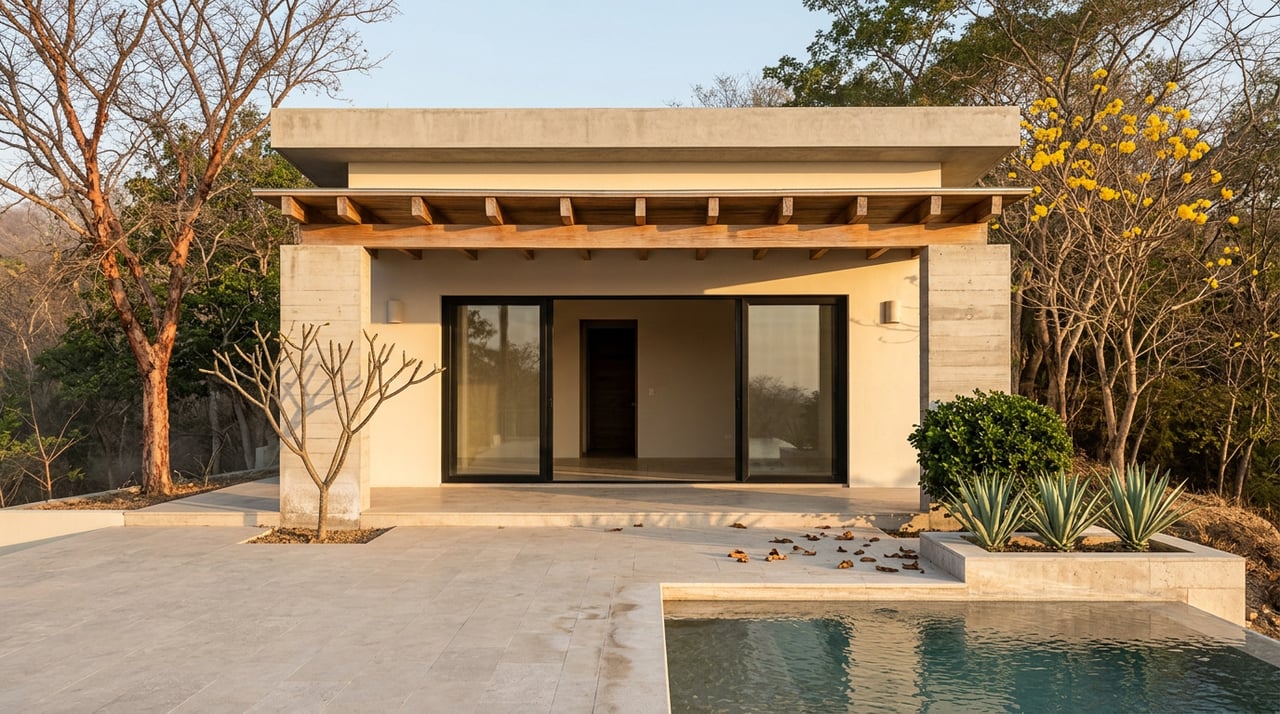
Why Water Availability Letters Matter in Guanacaste Real Estate
August 27, 2026
August 27, 2026
Two lots sit three miles apart outside Potrero. One has a paved access road, ocean glimpses through the trees, and a price that reflects all of it. The other is plainer, set back from the water, priced lower. On paper, the first lot is the better buy.
The difference has nothing to do with the deed. It comes down to a document most buyers don't ask about until they're already under contract: the carta de disponibilidad de agua, the water availability letter issued by AyA or a local ASADA. The Tico Times reports that without a current one, a municipality in Guanacaste will not issue a construction permit, and without that permit, you cannot register plans with the CFIA or get an electricity meter installed. A beautiful, fully titled lot with no water letter is, in practical terms, a lot you cannot build on yet.
Most guides to buying in Guanacaste spend their word count on the maritime zone. That topic matters, and it's well covered elsewhere. What gets skipped is the mechanism that actually gates construction across the entire province, coastline or not: water.
Not every document a seller calls a "water letter" carries the same weight. One type confirms that infrastructure exists to transport water to the area, pipes in the ground, essentially, but says nothing about whether water is actually flowing or allocated to that specific property.
The letters also expire. A positive determination typically holds for about twelve months. If construction hasn't started by then, the water board can require a fresh inspection. A seller telling you "we have a water letter" from three years ago is telling you almost nothing about whether that letter is still good.
As of early August 2026, roughly one in four development projects requesting a water availability determination in Costa Rica is being turned down, and AyA's own leadership has acknowledged there are zones where the existing system can no longer support new letters at all. Guanacaste is the province most often cited in that conversation, and for a straightforward reason: it's the driest region in the country, with a dry season that regularly runs from December through April and pushes temperatures into the mid-90s Fahrenheit.
This isn't a new problem dressed up as a 2026 headline. Voz de Guanacaste reported that, back in 2021, AyA had already suspended the ability of at least 30 ASADAs around Nicoya to issue new water letters at all, citing illegal wells, unregistered flows, and technical capacity that didn't meet minimum standards. Roughly 64 ASADAs across the province carried some form of irregularity on AyA's list at the time. The pattern the Tico Times described in August 2026 isn't an anomaly. It's the same structural constraint that's been tightening for years, now showing up in harder numbers.
The two relief projects with real scale behind them, PAAM and PAACUME, are not small fixes. PAAM would add roughly 2,500 liters per second (about 660 gallons per second) to the Central Valley system, and PAACUME is designed to bring potable water to more than half a million people across Guanacaste. Neither is expected to be operational before 2030. Anyone buying in the province today is buying into the water system as it exists now, not the one that's been promised.
If you want to understand why some pockets of Guanacaste are pulling ahead in value while others sit stagnant, the Nimboyores aqueduct is a useful lens. The project draws from an aquifer near the community of Lorena, feeds a line running more than 8 kilometers to Cerro Huacas, and from there splits into three pipelines: one toward Tamarindo, one toward Matapalo and Playa Grande, and one toward Brasilito, Playa Flamingo, and Playa Potrero. The infrastructure includes roughly 38 kilometers of pipeline and four storage tanks with a combined capacity of about 5,800 cubic meters, expandable to 7,800.
This has been under construction, in phases, for a long time. As of early 2026, The Lat Investor described it as "a multi-phase effort with sections coming online gradually." It's real infrastructure with real engineering behind it. That phased rollout is already reshaping which communities have dependable service.
What that means for buyers: the Potrero to Las Catalinas corridor, and the communities already connected into the coastal aqueduct's build-out, have become the sub-markets most frequently cited in 2026 analyses for above-asking activity on turnkey, water-secure properties. Surfside, the established residential pocket at the southern end of Potrero with its handful of restaurants, a pharmacy, a grocery store, and a sailing center, has built a reputation as a calmer, more reliably serviced alternative to busier stretches of coast. Playa Potrero itself sits on a wide, protected bay, five minutes from the Flamingo marina and a few minutes from the car-free community of Las Catalinas, with Tamarindo about 20 minutes south and Liberia International Airport roughly an hour away. None of that geography changed. What changed is which of these towns sit on a water system that's actually being expanded, and which don't.
As of early 2026, the average time on market for residential listings across Guanacaste ran around 340 days, an improvement from about 355 days the year before. That average hides a real split: well-priced, turnkey homes in established, water-secure locations like Tamarindo or Playas del Coco were moving in roughly 180 days, while overpriced or less desirable properties, often the ones with unresolved infrastructure questions, were sitting past 400.
The average sale-to-list ratio across the province sits around 93%, meaning most buyers are negotiating roughly 7% off asking. That's a buyer-friendly market on the surface. But the properties still commanding near-asking offers, the ones in the Potrero to Las Catalinas corridor specifically called out in 2026 market commentary, share a common thread: documented, current water access. Route 21's widening near Liberia International Airport, with a tender process anticipated for early 2026 and construction projected to run two to four years once it starts, has a similar effect on announcement alone, with infrastructure news reliably adding 5 to 10% to nearby property values even before a shovel goes into the ground.
Put together, the days-on-market gap and the sale-to-list resilience in specific corridors aren't really about school access or restaurant density. They're a market quietly pricing in water security before most buyers know to ask the question.
In Guanacaste specifically, water is treated as a genuinely limited resource rather than a formality to be checked off.
Does a water letter guarantee the water will keep flowing? No. Drought conditions, aquifer salinization, or a system-wide suspension like the one AyA imposed on dozens of Nicoya-area ASADAs can change that picture after the letter is issued.
If a property already has a well on-site, does that solve the problem? Not automatically. Water access still needs verification.
Will PAACUME or PAAM fix this before I'm ready to build? Almost certainly not on your timeline. Neither project is expected to be operational before 2030.
Is a titled lot automatically safer than one that touches the maritime zone? Titled land solves the ownership question. It does not solve the water question. Both need separate verification.
None of this makes Guanacaste a market to avoid. It makes it a market where the paperwork that actually matters isn't the one most guides talk about. Tropical Investments works across the Southern Pacific, San José, and Guanacaste, and part of what we do before a client falls for a view is find out whether the property can legally support the home they're picturing. If you're weighing a lot or a listing in this corridor, we're glad to walk through what the current water documentation actually says before you go further.
This article is general information, not legal, tax or financial advice. Consult a qualified professional about your situation.

It would be our honor to help you find the perfect Costa Rica real estate opportunity that matches your lifestyle and interests. Connect with us to get started on your real estate in Costa Rica journey!
Plaza Coco Uvita Local 6 2nd FL, Bahia Ballena, Puntarenas 60504, Costa Rica